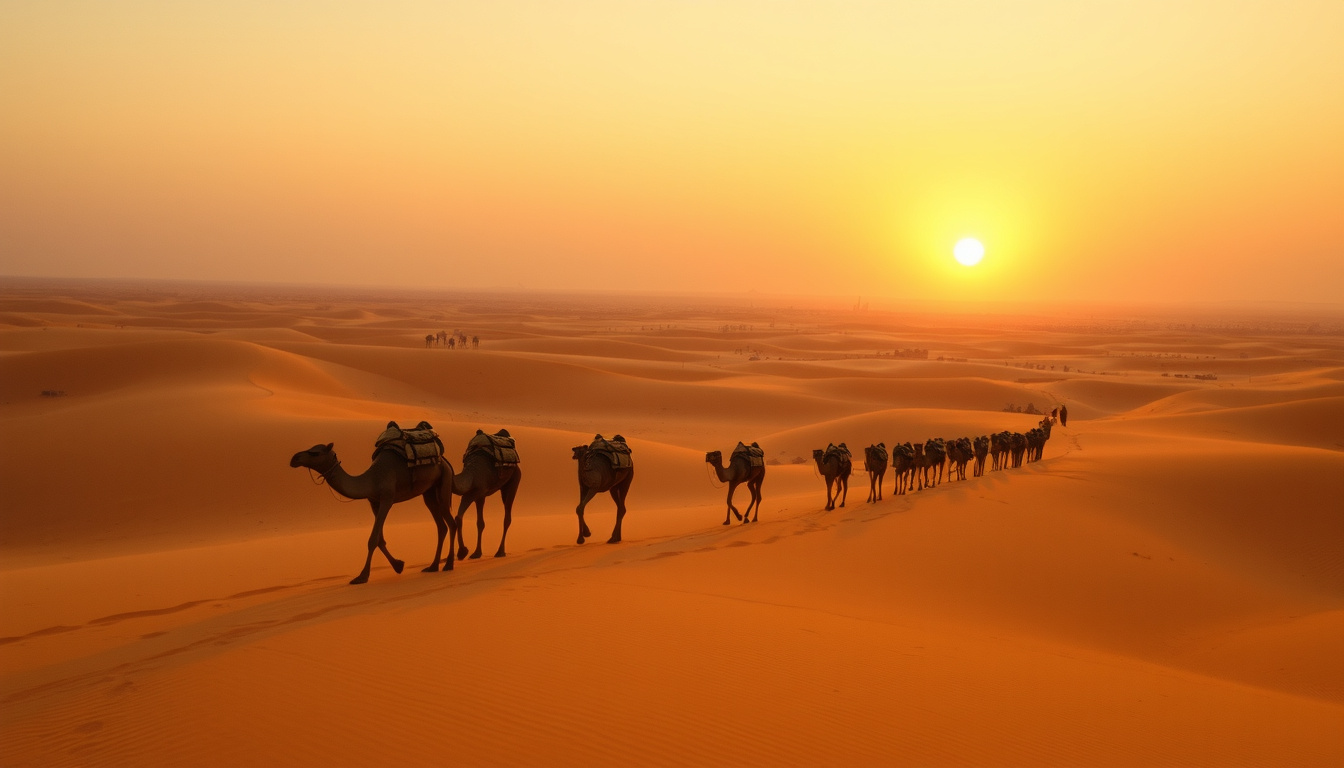
Few medieval figures still spark the imagination the way Mansa Musa does. His 1324 pilgrimage to Mecca included a caravan rumored at 60,000 people and so much gold that it is said to have crashed the Cairo economy for over a decade.
Estimated net worth (inflation-adjusted): $400 billion ·
Born: c. 1280 ·
Died: c. 1337 ·
Reign: 1312–1337 ·
Source of wealth: Gold and salt trade ·
Famous event: Pilgrimage to Mecca in 1324
Quick snapshot
- Ninth Mansa (emperor) of the Mali Empire (Britannica (authoritative encyclopedia))
- Ruled from 1312 to 1337 (World History Encyclopedia (academic reference))
- Famous for his immense wealth and hajj pilgrimage (BBC News (UK public broadcaster))
- Controlled West African gold and salt mines (Wikipedia (community-edited encyclopedia))
- Strategic position on trans-Saharan trade routes (Mises Institute (libertarian think tank))
- Collected tribute from conquered territories (Britannica (authoritative encyclopedia))
- Often compared to Elon Musk, Jeff Bezos, and Bill Gates (BBC News (UK public broadcaster))
- Inflation-adjusted wealth estimated at $400 billion+ (BBC News (UK public broadcaster))
- His pilgrimage distributed so much gold it caused inflation in Cairo (World History Encyclopedia (academic reference))
- Built the Great Mosque of Djenné and other architectural works (Britannica (authoritative encyclopedia))
- Made Timbuktu a center of learning (Britannica (authoritative encyclopedia))
- Influence on African history and global economics (Wikipedia (community-edited encyclopedia))
The table below summarizes the essential biographical details.
| Attribute | Value |
|---|---|
| Born | c. 1280 |
| Died | c. 1337 |
| Title | Mansa (Emperor) |
| Religion | Islam |
| Estimated net worth (inflation-adjusted) | ~$400 billion |
| Primary source of wealth | Gold and salt trade |
Why was Mansa Musa so rich?
Control of the gold and salt trade
- Mansa Musa inherited a kingdom rich in natural resources (Wikipedia (community-edited encyclopedia)).
- He directly controlled gold-producing regions of West Africa (Britannica (authoritative encyclopedia)).
- The trans-Saharan trade routes generated immense revenue (Mises Institute (libertarian think tank)).
Strategic location of the Mali Empire
- The empire sat at the crossroads of major trade routes connecting West Africa to North Africa and the Middle East (Mises Institute (libertarian think tank)).
- Its control over key cities like Timbuktu and Djenné allowed Musa to tax goods flowing through his territory (Britannica (authoritative encyclopedia)).
Economic policies and tribute systems
- Tribute from conquered territories added to the imperial treasury (Britannica (authoritative encyclopedia)).
- Contemporary Arabic sources suggest Musa actively promoted the appearance of vast wealth, even spreading rumors that gold grew like a plant in his kingdom (Wikipedia (community-edited encyclopedia)).
The implication: Musa’s economic dominance rested on controlling a commodity that had no substitute in the 14th-century global economy.
How rich was Mansa Musa today?
Inflation-adjusted net worth estimates
- In 2012, Celebrity Net Worth estimated his wealth at $400 billion (BBC News (UK public broadcaster)).
- However, historians and economists widely reject any precise number (Britannica (authoritative encyclopedia)).
- Most agree he controlled roughly half of the world’s gold supply at the time (World History Encyclopedia (academic reference)).
Comparison to modern billionaires
- Adjusted for inflation, his wealth surpasses Elon Musk and Jeff Bezos (BBC News (UK public broadcaster)).
- While modern billionaires’ net worth fluctuates with stock markets, Musa’s wealth was tangible gold and land—far less liquid but far more stable (World History Encyclopedia (academic reference)).
Limitations of estimating medieval wealth
- No contemporary records provide a complete inventory of his assets (Britannica (authoritative encyclopedia)).
- Arabic sources often used hyperbole to describe his riches (Wikipedia (community-edited encyclopedia)).
- Converting 14th-century gold holdings into modern dollars is inherently speculative (BBC News (UK public broadcaster)).
The catch: every dollar estimate is a guess, but the underlying scale—controlling half the world’s gold—puts him in a category no living billionaire can reach.
Who was the richest king in history?
Mansa Musa’s claim to the title
- Many historians consider Mansa Musa the wealthiest person ever (Britannica (authoritative encyclopedia)).
- His pilgrimage caravan reportedly included 60,000 people and an immeasurable amount of gold (Britannica (authoritative encyclopedia)).
- The Catalan Atlas of 1375 depicted Musa holding a gold nugget, calling him “the richest man in the region” (Wikipedia (community-edited encyclopedia)).
Other contenders: Genghis Khan, Augustus Caesar, etc.
- Genghis Khan controlled a massive empire but his personal wealth is not well documented.
- Augustus Caesar had the resources of the Roman Empire, but estimates of his net worth lag far behind Musa’s.
- Wealth is difficult to compare across eras (Britannica (authoritative encyclopedia)).
Criteria for measuring historical wealth
- Current consensus often places him at the top, but only if you measure by control of global economic resources (BBC News (UK public broadcaster)).
- By share of world GDP, Musa’s resources dwarfed any modern billionaire’s (World History Encyclopedia (academic reference)).
What this means: when the metric shifts from net worth to economic control, Musa has no historical rival.
Who’s richer, Mansa Musa or Elon Musk?
Mansa Musa’s estimated wealth vs Elon Musk’s current net worth
- Elon Musk’s net worth has peaked around $300 billion, while Mansa Musa’s inflation-adjusted estimates start at $400 billion (BBC News (UK public broadcaster)).
- The gap widens when you consider that Musa controlled a significant fraction of the entire world’s gold supply (World History Encyclopedia (academic reference)).
Inflation-adjusted comparisons
- Adjusted for inflation and GDP share, some analysts push Musa’s equivalent wealth past $400 billion, far beyond Musk (BBC News (UK public broadcaster)).
- However, such comparisons are inherently flawed because medieval gold-based wealth and modern equity wealth are fundamentally different (Britannica (authoritative encyclopedia)).
The nature of wealth: gold vs company stock
- Musk’s wealth is volatile—it can lose half its value in a market downturn. Musa’s gold, by contrast, was universally accepted and retained its value.
- The Mali Empire’s gold mines produced wealth that was both state-controlled and non-inflatable, giving Musa an economic power no modern billionaire can match (Mises Institute (libertarian think tank)).
The pattern: stock wealth is a claim on future earnings; gold wealth is a claim on the present—and Musa had more of it than anyone else in history.
Who was a trillionaire in history?
Mansa Musa as a trillionaire candidate
- No official trillionaire exists today, but Musa is often cited as a top candidate when historians adjust for GDP share (BBC News (UK public broadcaster)).
- His wealth controlled a significant portion of global GDP, potentially in the trillions when measured in modern terms (World History Encyclopedia (academic reference)).
Other historical figures often called trillionaires
- Emperor Shenzong of Song China, Genghis Khan, and Augustus Caesar are sometimes mentioned, but none had the combination of absolute control over a commodity like gold.
- The Roman Empire under Augustus was enormous, but its GDP per capita was far lower than the gold-rich Mali Empire.
Challenges in calculating historical net worth
- No complete financial records survive from Musa’s reign (Britannica (authoritative encyclopedia)).
- Arabic chroniclers wrote more to impress than to audit (Wikipedia (community-edited encyclopedia)).
- Comparing medieval gold holdings to modern net worth requires assumptions that can shift the estimate by orders of magnitude (BBC News (UK public broadcaster)).
The implication: calling him a trillionaire says more about our inability to measure his wealth than about the number itself.
Three figures, one pattern: the wealth gap between medieval emperors and modern billionaires is vast, but not in the direction you might expect.
| Attribute | Mansa Musa | Elon Musk | Jeff Bezos |
|---|---|---|---|
| Estimated net worth (inflation-adjusted) | ~$400 billion | ~$200–300 billion (peak) | ~$150–200 billion (peak) |
| Primary source of wealth | Gold and salt (tangible commodity) | Company stock (Tesla, SpaceX) | Company stock (Amazon) |
| Global economic control | Controlled ~50% of world gold supply | Owns a small share of automotive/space markets | Controls ~1% of global e-commerce |
| Wealth stability | Extremely stable (gold is timeless) | Highly volatile (stock market fluctuations) | Moderately volatile |
| Contemporary perception | Widely considered richest person in history | Richest living person (as of 2024) | Second-richest living person |
Elon Musk and Jeff Bezos have never crashed an entire country’s economy by spending too much. Mansa Musa did—and it took Cairo’s gold market 12 years to recover, according to World History Encyclopedia (academic reference).
Timeline of Mansa Musa’s Life and Reign
- – Birth of Mansa Musa (BBC News (UK public broadcaster))
- – Became Mansa of the Mali Empire (Britannica (authoritative encyclopedia))
- – Pilgrimage to Mecca (Hajj) (Britannica (authoritative encyclopedia))
- – Stopped in Cairo, gave 50,000 gold dinars to the sultan (World History Encyclopedia (academic reference))
- – Distributed vast amounts of gold in Cairo, causing economic disruption; gold dinar value fell 20% (World History Encyclopedia (academic reference))
- – Death of Mansa Musa (BBC News (UK public broadcaster))
Confirmed facts
- Mansa Musa was the ninth ruler of the Mali Empire (Britannica (authoritative encyclopedia))
- He undertook a famous pilgrimage to Mecca in 1324 (Britannica (authoritative encyclopedia))
- He controlled major gold-producing regions (Wikipedia (community-edited encyclopedia))
- His gold distribution in Cairo is documented by historical sources (World History Encyclopedia (academic reference))
- He built the Great Mosque of Timbuktu (Britannica (authoritative encyclopedia))
What’s unclear
- Exact net worth in modern terms (estimates vary widely) (BBC News (UK public broadcaster))
- Cause of his death (Britannica (authoritative encyclopedia))
- Details of his early life before becoming Mansa (Wikipedia (community-edited encyclopedia))
- Reliability of inflation-adjusted estimates (no medieval balance sheet exists) (BBC News (UK public broadcaster))
- How many wives he had (no reliable records) (Wikipedia (community-edited encyclopedia))
Perspectives on Mansa Musa
“Musa I is widely considered to be the wealthiest person in history.”
Britannica (authoritative encyclopedia)
“The caravan in 1324 comprised some 60,000 people and an immeasurable amount of gold.”
Britannica (authoritative encyclopedia)
“He gave 50,000 gold dinars to the sultan of Egypt as a gesture of goodwill. The value of the gold dinar in Cairo crashed by 20% after his spending spree and took 12 years to recover.”
World History Encyclopedia (academic reference)
The gap between Mansa Musa’s wealth and that of any modern individual is not just about numbers—it’s about the nature of power. Musa’s gold was the lifeblood of the medieval global economy, and his choices could distort markets continents away. For today’s billionaires, the lesson is humbling: no amount of stock can rival the economic influence of controlling the world’s most desired commodity. For students of history, Mansa Musa remains the benchmark against which all extreme wealth is measured—and a reminder that the richest person who ever lived was not a robber baron or a tech founder, but an emperor from 14th-century West Africa.
Related reading: **Isaac Newton: Biography, Laws, IQ, Predictions & Facts**
our-ancestories.com, buysidedigest.com, thehistorycat.com, facebook.com, reddit.com, reddit.com, thehumanityarchive.com, nyhetskoll.net
Frequently asked questions
Did Mansa Musa have children?
Yes, historical records indicate he had several children, but sources are scarce on their names and fates. His successor was his son Maghan I.
What was Mansa Musa’s religion?
He was a devout Muslim. His pilgrimage to Mecca is one of the best-documented events of his reign (Britannica (authoritative encyclopedia)).
How did Mansa Musa die?
The exact cause of his death is unknown. He died around 1337 likely of natural causes (Britannica (authoritative encyclopedia)).
Where is Mansa Musa buried?
His burial site is not known with certainty. Some traditions suggest he was buried in the Mali Empire, but no tomb has been identified.
How much gold did Mansa Musa distribute?
According to World History Encyclopedia (academic reference), he gave 50,000 gold dinars to the Sultan of Egypt, and his overall spending in Cairo devalued gold by 20%.
What is the Mali Empire today?
The Mali Empire covered parts of modern-day Mali, Senegal, Guinea, and Niger. Its legacy remains strong in West African culture and history.
Was Mansa Musa a Muslim?
Yes, he was a practicing Muslim. His hajj to Mecca in 1324 is one of the most famous pilgrimages in history (Britannica (authoritative encyclopedia)).

Freddie Clarke is Senior Reporter at WordPatch.co.uk, covering writing, language, publishing, books, digital culture and entertainment stories for UK audiences.