There are artists whose work you admire, and then there are artists whose work you feel. Louise Bourgeois belongs firmly to the second camp.
Quick snapshot
- Her father’s affair with the governess is documented in Bourgeois’s memoirs (Guggenheim Museum Bilbao)
- Maman was created as a tribute to her mother (Guggenheim Museum Bilbao)
- She said “Art is a guarantee of sanity” (National Gallery of Canada)
- The spider motif first appeared in Bourgeois’s drawings in the 1940s and became central in the 1990s (Guggenheim Museum Bilbao)
- Maman was first exhibited at Tate Modern in London in 2000 (MyArtBroker)
Bourgeois didn’t just make art about pain — she turned the act of making into a survival mechanism. For anyone navigating the line between personal history and public expression, that Maman still towers over museum entrances twenty years on proves her method worked.
Six facts that frame the artist’s life and work:
| Full name | Louise Joséphine Bourgeois |
| Birth–death | 25 December 1911 – 31 May 2010 |
| Nationality | French-American |
| Education | Académie de la Grande Chaumière; École des Beaux-Arts |
| Best-known work | Maman (1999), a 9-metre-tall spider sculpture |
| Art movements | Modernism, Surrealism, Feminism |
The pattern is consistent: Bourgeois made the personal monumental, and the facts confirm her method.
What Was Louise Bourgeois’ Trauma?
Childhood abandonment
Bourgeois grew up in a household where her father, Louis Bourgeois, openly carried on a long-term affair with the family governess, Sadie. The affair lasted years, and Bourgeois later described feeling betrayed not only by her father but also by her mother, who tolerated it. As she told an interviewer, “I felt abandoned” (National Gallery of Canada).
Father’s affair with the governess
In Louise Bourgeois: The Woven Child, the artist’s notebooks detail how the affair created an atmosphere of secrecy and shame in the family home. The governess was not dismissed; instead, Bourgeois was expected to pretend nothing was wrong. That dissonance between outward appearances and inner reality would become a central theme in her work (Guggenheim Museum Bilbao).
Mother’s illness and death
Compounding the betrayal, Bourgeois’s mother, Joséphine, suffered from tuberculosis and became bedridden. At age 21, Bourgeois lost her mother and soon after attempted suicide. She later said the loss “cut the only tie that kept me attached to the world” (National Gallery of Canada).
Trauma wasn’t a single event for Bourgeois — it was a web of abandonment, complicity, and death that stretched across her adolescence. She spent the rest of her life untangling it through art.
Why Is Louise Bourgeois So Famous?
Bourgeois became one of the most influential artists of the 20th century precisely because she refused to compartmentalise her pain. Where many artists hid autobiography, she made it the raw material.
Pioneering large-scale sculpture
Before Bourgeois, sculpture was largely about solid, upright forms. She introduced soft materials — latex, fabric, found objects — and built environments that surrounded the viewer. Her Cells series (1990s) contains enclosures filled with objects that evoke memory and fear. The Tate Modern holds multiple Cells works in its permanent collection (Wikipedia).
Emotional depth and autobiography
Bourgeois said, “Sculpture is the body. My body is my sculpture.” Every piece carries the weight of her biography. The spider, the house, the spiral — each motif recurs as a psychological signpost. Art historians argue this autobiographical charge is why her work resonates across generations (Singulart).
Influence on feminist art
While Bourgeois rejected the label “feminist artist,” her focus on domesticity, the maternal body, and female experience opened doors for later generations. The Brooklyn Museum’s Elizabeth A. Sackler Center for Feminist Art includes her work in its core exhibition (Wikipedia).
The implication: fame came late. Bourgeois was in her 70s before she received a major retrospective (MoMA, 1982). She worked in relative obscurity for decades, proving that long careers often outlast critical neglect.
What Was Louise Bourgeois’s Relationship With Her Mother?
The mother as protector and weaver
Joséphine Bourgeois ran a tapestry restoration workshop in the family home. Bourgeois spent hours watching her mother mend worn tapestries, threading needles with patience and precision. She later described her mother as “intelligent, subtle, and protective” (Guggenheim Museum Bilbao).
Maman as a tribute
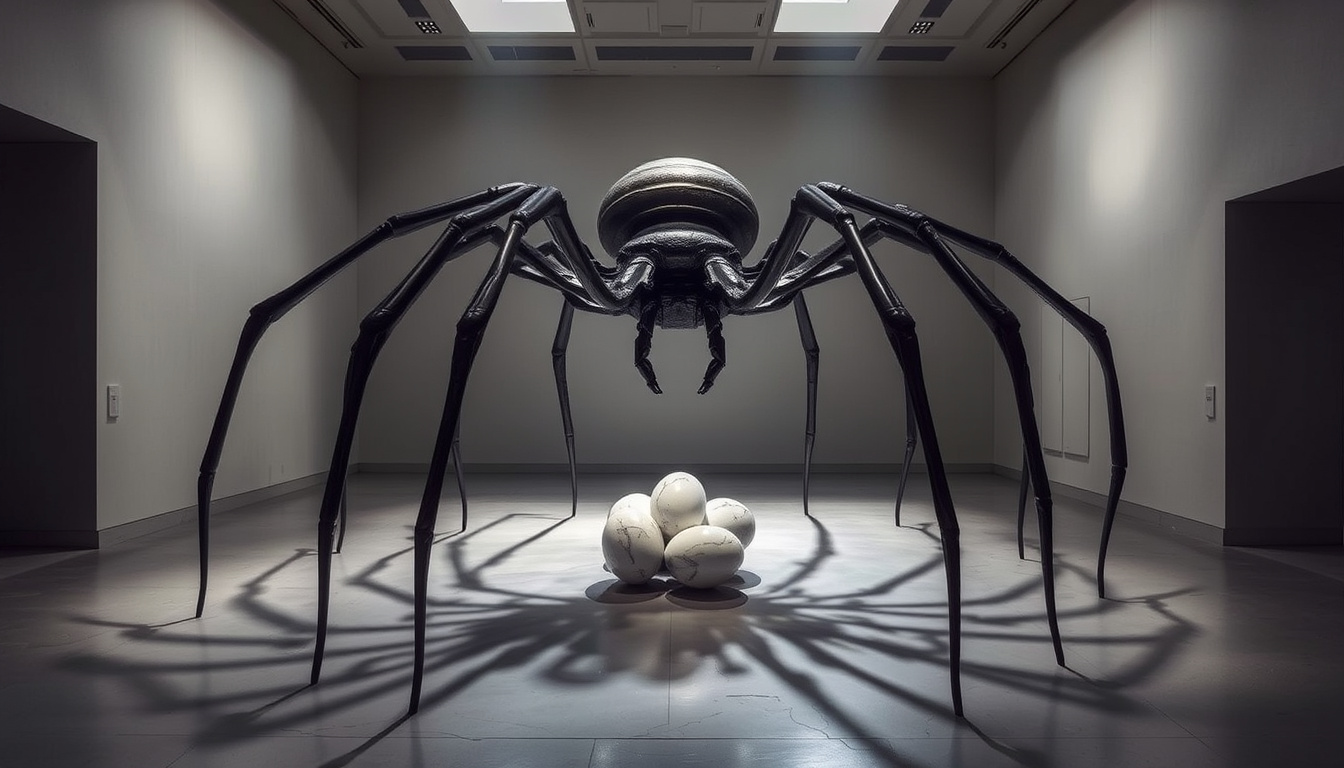
The giant spider Maman — bronze, marble, and stainless steel, standing almost 9 metres tall — was explicitly created as an ode to her mother. Bourgeois said, “The spider is an ode to my mother. She was my best friend. Like a spider, my mother was a weaver” (Guggenheim Museum Bilbao). The protective cage of the spider’s body also holds a marble egg sac, symbolising nurture and fecundity.
Mother’s illness and Bourgeois’s care
When her mother fell ill with tuberculosis, Bourgeois became her primary caregiver. This experience of tending to a dying body while still grieving her father’s emotional absence deepened her understanding of empathy and loyalty. The contradictions in the spider — protector and predator — reflect the ambivalence she felt toward her mother’s complicity in the father’s affair (Guggenheim Museum Bilbao).
What this means: the mother is both the source of protection and the wound. Bourgeois never fully resolved that duality, but she gave it a permanent home in public space.
What Is the 70/30 Rule in Art?
The 70/30 rule is widely attributed to Bourgeois’s teaching, but no primary source confirms she used those exact percentages. It’s one of those art-school legends that has more traction in classrooms than in archives.
Originally from Bourgeois’s teaching
According to design-education lore, Bourgeois advocated that 70% of a work should be conscious (planned, reasoned) and 30% unconscious (intuitive, accidental). The rule is sometimes cited in painting and design courses as a guideline for balancing control with spontaneity. Singulart notes that “the 70/30 rule is a likely interpretive shorthand rather than a documented art-historical principle” (Singulart).
Application in composition and color
In practice, the rule suggests that two-thirds of a composition should carry the main visual weight, while the remaining third provides breathing room or contrast. It echoes older principles like the golden ratio but is far more flexible. Bourgeois herself never wrote a formal treatise on it, which is why scholars remain cautious.
Critiques of the rule
Art critic Charlotte Higgins has pointed out that “trauma resists tidy ratios” — a good reminder that Bourgeois’s work is too messy to be bound by maths. The rule remains popular in workshops but has no official citation in Bourgeois’s archives or interviews.
The catch: whether Bourgeois invented it or not, the 70/30 idea is useful as a teaching tool. But treating it as a fact about her practice would be like calling Picasso’s Guernica a colour-wheel exercise.
What Was Louise Bourgeois’s Famous Quote?
“Art is a guarantee of sanity”
Perhaps her most cited line, this comes from a 1986 interview. The full statement: “Art is a guarantee of sanity. That is the most important thing I have to tell you.” She repeated variations: “Art is the guarantee of health.” It encapsulates her belief that creative work was not a luxury but a necessity for psychological survival (National Gallery of Canada).
“My art is the expression of my emotions”
Bourgeois frequently turned the camera back on herself: “My art is the expression of my emotions. It is not about representation. It is about the expression of internal states.” This quote appears in multiple catalogue essays and is often paired with her spider imagery.
“The spider is an ode to my mother”
Speaking about Maman at the time of its unveiling, Bourgeois said, “The spider is an ode to my mother. She was my best friend. She was a weaver. Like a spider, she was very industrious and intelligent” (Guggenheim Museum Bilbao).
The pattern across all her quotes is emotional honesty. Bourgeois never pretended art was merely decorative. For her, it was the difference between staying intact and falling apart.
Timeline: Seven Decades of Making
- 1911: Born in Paris to Louis and Joséphine Bourgeois (Wikipedia)
- 1932: Mother dies of tuberculosis; Bourgeois attempts suicide (National Gallery of Canada)
- 1938: Marries art historian Robert Goldwater, moves to New York (Wikipedia)
- 1950s: First solo exhibitions, begins working in sculpture (Wikipedia)
- 1982: First retrospective at the Museum of Modern Art, New York (Wikipedia)
- 1999: Reveals Maman at Tate Modern’s opening (Guggenheim Museum Bilbao)
- 2010: Dies in New York at age 98 (Wikipedia)
The pattern shows a life where personal tragedy was channelled directly into artistic production, each decade adding new layers to an evolving practice.
What We Know for Certain — and What We Don’t
Confirmed facts
- Her father’s affair with the governess is documented in Bourgeois’s memoirs (Guggenheim Museum Bilbao)
- Maman was created as a tribute to her mother (Guggenheim Museum Bilbao)
- She said “Art is a guarantee of sanity” (National Gallery of Canada)
- The spider motif first appeared in her drawings in the 1940s (Guggenheim Museum Bilbao)
- Maman is made of bronze, marble, and stainless steel and stands nearly 9 metres tall (Guggenheim Museum Bilbao)
- Her mother was a tapestry restorer (Guggenheim Museum Bilbao)
What remains uncertain
- The exact origin of the 70/30 rule is debated — Bourgeois used it, but it appears in earlier design theory (Singulart)
- Whether she ever officially diagnosed herself with any mental health condition is not proven
- Some sources claim Maman is 10 metres tall, but the Guggenheim Bilbao lists it as “almost 9 metres” (London Art Roundup)
Bourgeois in Her Own Words
“Art is a guarantee of sanity. That is the most important thing I have to tell you.”
— Louise Bourgeois, 1986 interview (National Gallery of Canada)
“The spider is an ode to my mother. She was my best friend. She was a weaver. Like a spider, she was very industrious and intelligent.”
— Louise Bourgeois, on Maman (Guggenheim Museum Bilbao)
“Sculpture is the body. My body is my sculpture.”
— Louise Bourgeois, from Destruction of the Father / Reconstruction of the Father (1992)
Her words share a common thread: they insist that making art is not an escape from pain but a way of inhabiting it honestly. For Bourgeois, the studio was a therapy room where the patient never leaves.
The Lesson Bourgeois Leaves Us
For a deeper look into her life and the symbolism behind her iconic sculptures, see this Louise Bourgeois biography and spider meaning.
Frequently asked questions
What is the meaning behind Bourgeois’s spider sculptures?
The spider represents her mother, whom she described as protective, industrious, and intelligent. The spider’s web-building evokes her mother’s work as a tapestry restorer. At the same time, the spider is a predator, reflecting the ambivalence Bourgeois felt toward her mother’s complicity in her father’s affair (Guggenheim Museum Bilbao).
Where can I see Louise Bourgeois’s work?
Major collections include the Tate Modern (London), the Museum of Modern Art (New York), the Centre Pompidou (Paris), and the Guggenheim Bilbao. Maman is on permanent display at the Guggenheim Bilbao and also at the National Gallery of Canada (Wikipedia).
Why did Louise Bourgeois use fabrics and soft materials?
Fabrics and soft materials carried personal associations for Bourgeois. Her family’s tapestry business meant textiles were part of her childhood. Late in life, she created works using her own clothing and linens, stitching them into forms that reference the body and domesticity (MyArtBroker).
What psychological themes does Bourgeois explore?
Themes include abandonment, betrayal, the maternal bond, fear of intimacy, and the struggle for autonomy. Her Cells series places the viewer inside claustrophobic rooms filled with objects that evoke memory and threat (Singulart).
Did Louise Bourgeois believe in the 70/30 rule?
She taught it in her classes at the Pratt Institute and elsewhere, but no primary document confirms she originated the exact ratio. It remains a popular teaching tool, not a documented art principle (Singulart).
How did Bourgeois connect art and therapy?
She explicitly said that art-making was a way to manage psychological distress. “Art is a guarantee of sanity” is her most quoted statement on the subject. She saw the creative act as a method for transforming trauma into form (National Gallery of Canada).

Freddie Clarke is Senior Reporter at WordPatch.co.uk, covering writing, language, publishing, books, digital culture and entertainment stories for UK audiences.