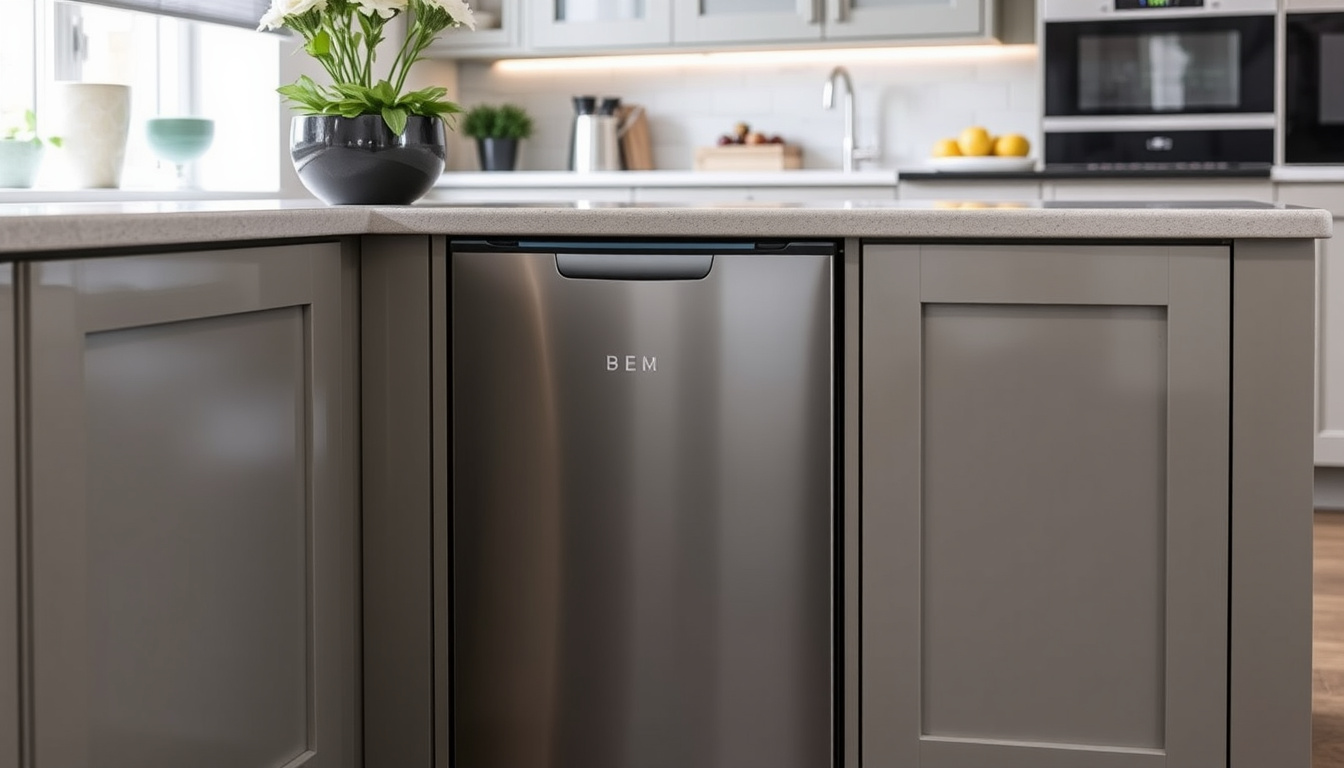
You’ve spent weeks choosing the perfect kitchen cabinets, only to realise a bulky freestanding fridge would ruin the whole look. That’s where an integrated fridge comes in — it hides behind a cabinet door so your kitchen stays seamless, and this guide walks through the types, sizes, prices, and energy-labelling rules that matter most for Irish homes.
Typical width of integrated fridges: 55–60 cm · Average price range in Ireland: €500 – €2,000 · Common energy efficiency rating: A+ to A+++ · Most popular split type: 70/30 (fridge/freezer) · Standard built-in height: 178 cm
Quick snapshot
- Integrated fridges are designed to be hidden behind cabinet doors (Currys Ireland (major Irish electrical retailer))
- Most models are available in 70/30 or 50/50 splits (Expert Ireland (specialist appliance retailer))
- Frost-free technology is standard on many modern integrated fridges (Expert Ireland) (Currys Ireland (major Irish electrical retailer))
- Since March 2021, Ireland uses rescaled A–G energy labels for refrigerators (SEAI (Ireland’s sustainable energy authority))
- Exact market share of integrated vs freestanding fridges in Ireland
- Future trends in energy efficiency standards for integrated fridges
- Long-term reliability of specific brands across all models
- Long-term cost comparison between integrated and freestanding fridges in Ireland
- Availability of spare parts for older integrated fridge models
- 1 March 2021: EU rescaled A–G energy label takes effect for household refrigerators in Ireland (SEAI) (Bosch Home Ireland (appliance manufacturer))
- New labels include a QR code linking to an EU product database (Bosch Home Ireland (appliance manufacturer))
- Expect more integrated fridges with smart features and Wi-Fi connectivity (Joyces (Irish home appliance retailer))
- Energy efficiency standards may tighten further under EU ecodesign updates (Joyces (Irish home appliance retailer))
- Irish retailers continue to expand nationwide delivery for integrated models (Joyces (Irish home appliance retailer))
Six key specifications define any integrated fridge model.
| Specification | Typical value |
|---|---|
| Width | 55–60 cm |
| Height | 177–180 cm (full-height) / 82 cm (undercounter) |
| Depth | 55–60 cm (including door) |
| Typical Price | €500 – €2,000 |
| Energy Efficiency | A+ to A+++ |
| Common Split | 70/30 (fridge/freezer) |
What is an integrated fridge freezer?
An integrated fridge freezer is designed to sit flush with your kitchen cabinets and be hidden behind a matching cabinet door. This creates a continuous, uninterrupted look that many Irish homeowners prefer for modern fitted kitchens. According to Currys Ireland (major Irish electrical retailer), integrated fridges are built specifically for fitted kitchens, where cabinet fit, ventilation, and door fixing matter as much as style.
How does an integrated fridge freezer differ from a standard fridge?
- Standard freestanding fridges stand alone and are visible, while integrated models are concealed behind a cabinet door.
- Integrated fridges require ventilation gaps (typically 5 cm at the back) and often need a custom door panel, as noted by Expert Ireland (specialist appliance retailer).
- Freestanding fridges are easier to install and move, but integrated models deliver a premium, seamless look.
The implication: if you’re planning a new kitchen or replacing an old integrated unit, the commitment to cabinet-matching is worth it for the visual payoff. Irish homeowners who prioritise design coherence often choose integrated over freestanding.
What are the main advantages of an integrated fridge freezer?
- Seamless kitchen design — the fridge disappears behind the cabinetry.
- Frees up floor space because the unit is built into the cabinet run.
- Many models offer frost-free operation, reducing manual defrosting (Expert Ireland).
- Available in 70/30, 60/40, and 50/50 splits to suit different household needs.
The trade-off: you sacrifice flexibility — once installed, it’s not easy to swap out. For renters or those who move often, a freestanding unit may be more practical.
What are the different sizes of integrated fridges?
Integrated fridges come in three main size categories: full-height, undercounter, and small (compact) models. The choice depends on your kitchen layout and storage needs.
What is a small fridge integrated?
Small integrated fridges are typically 55–60 cm wide and 50–60 cm high. They are often called larder fridges and are ideal for households that already have a separate freezer. Expert Ireland recommends these where separate freezer storage already exists. An example from Euronics Ireland (Irish appliance retailer) lists a built-under integrated fridge with a 172-litre capacity.
How does an undercounter fridge integrated work?
Undercounter integrated fridges fit beneath standard worktops, usually at a height of 82 cm. They are designed to slide into a 60 cm wide cabinet space and often have a lower capacity (around 100–150 litres). They are popular in small kitchens, apartments, or as extra chilled storage in home bars. Currys Ireland notes that both undercounter and tall models are sold across the Irish market.
Why this matters: if you have a compact kitchen in an Irish city apartment, an undercounter integrated fridge can free up valuable counter space while maintaining a clean look.
How much does a cheap integrated fridge cost?
Prices for entry-level integrated fridges in Ireland start around €500, according to market listings from Currys Ireland and Expert Ireland. Higher-end models with frost-free technology, larger capacities, or better energy ratings can exceed €2,000.
Where can I find budget integrated fridges in Ireland?
- Euronics Ireland — regular sales on integrated refrigeration.
- Harvey Norman — clearance events and online deals.
- Joyces — nationwide delivery and competitive pricing (Joyces (Irish home appliance retailer)).
- Cunniffe Electric — offers a range of integrated larder fridges with energy consumption data (Cunniffe Electric (Irish appliance retailer)).
What features are sacrificed in cheaper models?
Budget models often have lower energy ratings (A+ rather than A+++), no frost-free technology, and fewer internal storage options. They may also be noisier. Expert Ireland notes that a fitted or integrated fridge can be selected as frost-free or low-frost, but cheaper models typically skip this feature.
The catch: saving €200 upfront might cost you more in electricity bills over time, especially if you choose a less efficient model.
What does ‘frost free’ mean in an integrated fridge?
Frost-free technology uses a fan to circulate air and prevent ice buildup inside the freezer compartment. This eliminates the need for manual defrosting, which is a common chore with older fridges.
How does frost free technology work?
According to Expert Ireland, frost-free systems rely on a fan that moves cold air evenly, preventing moisture from settling and freezing. Some models also have an auto-defrost cycle that melts any ice that does form.
Is frost free worth the extra cost?
For most Irish households, yes. Frost-free models save time and effort, and they keep food fresher because temperature stays more consistent. However, they are typically more expensive and may consume slightly more energy due to the fan. Expert Ireland advises weighing the convenience against the higher upfront cost — for busy families, the convenience usually wins.
The trade-off: if you rarely defrost and don’t mind the occasional ice buildup, a low-frost or manual defrost model can save you money.
What is a 70/30 integrated fridge freezer?
A 70/30 split means 70% of the total capacity is refrigerator space and 30% is freezer space. This is the most common configuration in Ireland because many households use more fresh food than frozen.
How does a 70/30 split compare to 50/50 or 60/40?
Expert Ireland explains that a 70/30 gives more chilled food space and is often better for fresh-food households. A 50/50 split suits homes that use frozen food more often, while 60/40 is a middle ground. The choice depends on your shopping habits and family size.
Which split is best for Irish households?
For a typical Irish family of four, a 70/30 integrated fridge freezer is a practical choice because it accommodates fresh groceries, dairy, and vegetables while still offering enough freezer space for frozen meals and ice cream. Brands like Bosch Home Ireland, Beko, and Neff offer 70/30 models widely available in Irish stores.
The pattern: 70/30 dominates Irish retail listings, confirming it’s the go‑to split for most households.
Three common splits, one key difference: the balance between fridge and freezer space determines which suits your kitchen.
| Split type | Fridge capacity | Freezer capacity | Best for |
|---|---|---|---|
| 70/30 | ~70% | ~30% | Fresh-food households |
| 60/40 | ~60% | ~40% | Balanced use |
| 50/50 | ~50% | ~50% | Heavy freezer users |
What this means: choose 70/30 if you shop fresh weekly and freeze leftovers; choose 50/50 if you batch cook and freeze meals.
Five dimensions that vary across integrated models, one pattern: undercounter units are shorter but the same width.
| Specification | Full-height (70/30) | Undercounter | Small larder |
|---|---|---|---|
| Width | 55–60 cm | 55–60 cm | 55–60 cm |
| Height | 177–180 cm | 82 cm | 50–60 cm |
| Depth | 55–60 cm | 55–60 cm | 55–60 cm |
| Capacity | 200–350 L | 100–150 L | 80–120 L |
| Energy label (new scale) | A–D | A–D | A–D |
| Frost-free option | Common | Available | Limited |
Upsides
- Seamless kitchen design — fridge hides behind cabinet door
- Frees up floor space and creates a built-in look
- Frost-free models reduce maintenance
- Wide range of sizes and splits available in Ireland
Downsides
- Higher upfront cost than freestanding models
- Requires professional installation and ventilation gaps
- Less flexible — can’t easily move or replace
- Repairs can be more expensive due to built-in design
What we know for sure — and what’s still open
Confirmed facts
- Integrated fridges are designed to fit flush with kitchen cabinets (Currys Ireland)
- They require ventilation gaps (typically 5 cm at the back) (Expert Ireland)
- Most models are available in 70/30 or 50/50 splits (Expert Ireland)
- Frost free technology is standard on many modern integrated fridges (Expert Ireland)
- Since March 2021, Ireland uses a rescaled A–G energy label for refrigerators (SEAI)
What’s unclear
- Exact market share of integrated vs freestanding fridges in Ireland
- Future trends in energy efficiency standards for integrated fridges
- Long-term reliability of specific brands across all models
- Long-term cost comparison between integrated and freestanding fridges in Ireland
- Availability of spare parts for older integrated fridge models
“Integrated fridges are designed to fit behind a cabinet door for a seamless kitchen look.”
“Proper installation for built-in refrigeration requires measuring cabinet height, width, and depth, plus checking ventilation space and hinge type.”
For Irish homeowners planning a fitted kitchen, the choice between integrated and freestanding comes down to design priority over flexibility. If you value a seamless, custom look and are willing to invest in installation and future repairs, an integrated fridge is the right call. For those who may move homes or prefer lower upfront costs, freestanding remains a practical alternative. The bottom line: measure your cabinet space, check the energy label, and decide whether frost-free convenience is worth the premium.
Related reading: Integrated fridge freezer buying and installation guide · EU energy label requirements for refrigeration appliances in Ireland
For a deeper look at the different sizes and features available, check out this guide on integrated fridge sizes and features for UK and Irish kitchens.
Frequently asked questions
Do integrated fridges need ventilation?
Yes, most models require a ventilation gap of about 5 cm at the back to allow heat to escape. Check the manufacturer’s instructions for exact requirements.
Can I install an integrated fridge myself?
It’s possible but not recommended unless you’re experienced. The fridge needs to be properly aligned, ventilated, and fitted with a cabinet door. Professional installation ensures warranty validity.
How long do integrated fridges last?
Typically 10–15 years, depending on brand, usage, and maintenance. Regular cleaning and proper ventilation extend lifespan.
Are integrated fridges more expensive to repair?
Repair costs can be higher because the unit is built into the cabinetry, requiring more labour to access. Some repairs may also require specialist parts.
What is the difference between integrated and built-in?
“Integrated” usually means the fridge fits behind a cabinet door and is fully concealed. “Built-in” can refer to a freestanding fridge that’s slid into a cabinet space but still visible. The terms are sometimes used interchangeably, but integrated is the true hidden option.
Can I use an integrated fridge without a cabinet door?
Technically yes, but it defeats the purpose. The fridge will have unfinished sides and the kitchen will look incomplete. Retailers like Currys Ireland note that integrated fridges are meant to be hidden.
How to clean an integrated fridge?
Unplug the fridge, remove shelves and drawers, and wash them with warm soapy water. Wipe interior surfaces with a mild cleaner. Clean the condenser coils at the back annually to maintain efficiency.
Related reading: Integrated fridge freezer buying and installation guide · EU energy label requirements for refrigeration appliances in Ireland

Freddie Clarke is Senior Reporter at WordPatch.co.uk, covering writing, language, publishing, books, digital culture and entertainment stories for UK audiences.