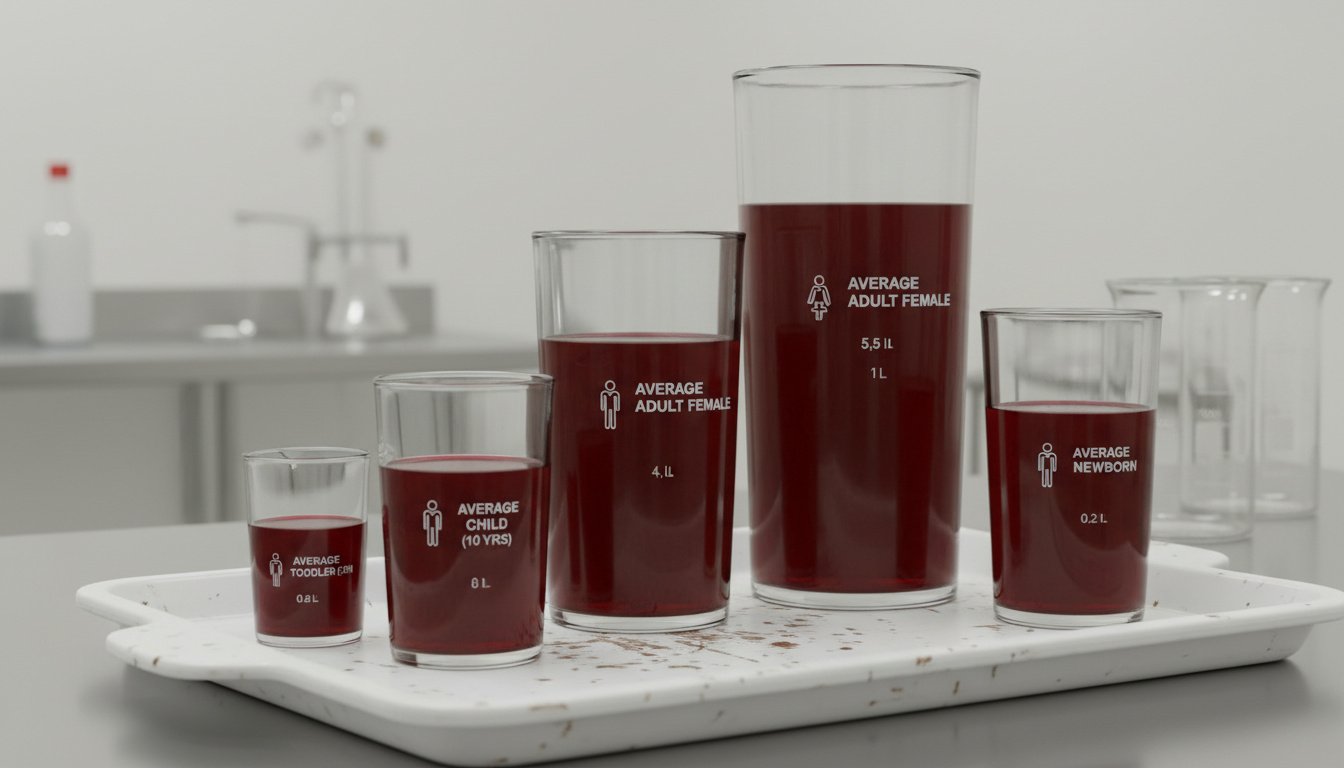
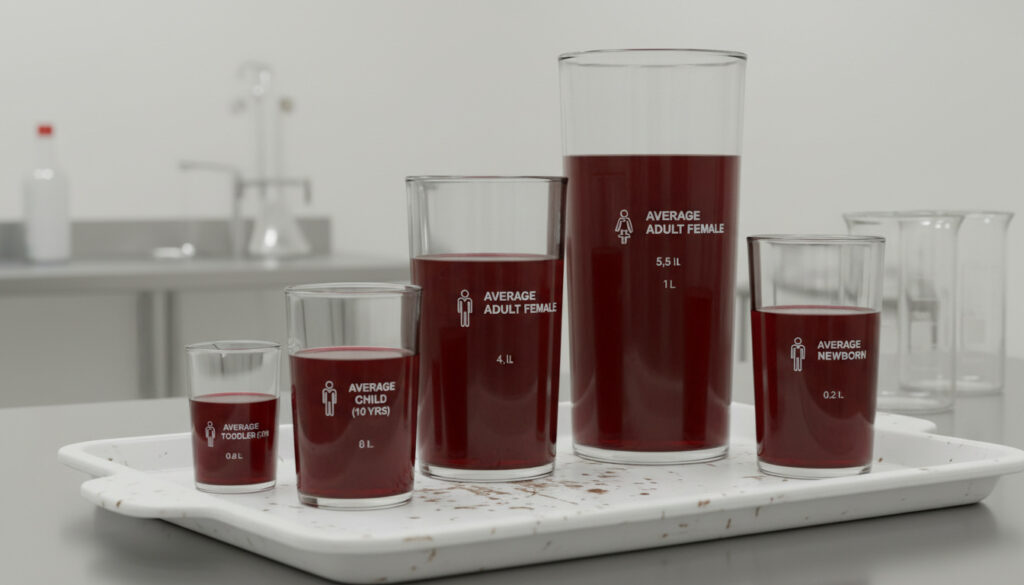
Blood constitutes approximately 7% to 8% of total body weight in healthy adults, translating to roughly 10 to 12 pints for most individuals. This vital fluid circulates continuously, delivering oxygen to tissues, regulating body temperature, and removing metabolic waste products.
An average adult male maintains approximately 5.5 liters of blood—equivalent to 11.6 pints—while adult females typically carry around 4.5 liters or 9.5 pints. These baseline figures fluctuate significantly based on age, body mass, sex, and physiological conditions such as pregnancy according to clinical data.
Understanding these volumes proves essential for surgical planning, trauma assessment, and blood donation safety protocols. Medical professionals rely on precise measurements to determine transfusion needs and monitor hemorrhage severity.
How Many Pints of Blood Are in the Average Human Body?
Adult Male (pints)
Adult Female (pints)
Newborn (pints)
Per kg Body Weight (pints)
- Blood comprises 7-8% of adult body weight, increasing to 8-9% in children and 9-10% in infants.
- A standard donation removes approximately 1 pint—roughly 10% of total circulating volume.
- Plasma volume restores within 24 to 48 hours following fluid intake.
- Males average 70 milliliters per kilogram of body weight; females average 65 ml/kg.
- During pregnancy, female blood volume expands by 30% to 50%.
- Critical hemorrhage classifications begin at 30% to 40% volume loss.
- One liter converts to approximately 2.11 US pints.
| Demographic | Pints | Liters | Notes |
|---|---|---|---|
| Newborn | 0.57 | 0.27 | ~1 cup (75-100 ml/kg) |
| 1-Year-Old | 1.05 | 0.50 | ICRP reference values |
| 5-Year-Old | 2.96 | 1.40 | ICRP reference values |
| 10-Year-Old | 5.07 | 2.40 | ICRP reference values |
| 15-Year-Old Male | 9.51 | 4.50 | ICRP reference values |
| 15-Year-Old Female | 6.97 | 3.30 | ICRP reference values |
| Adult Male (70kg) | 10.5-12.0 | 5.0-5.7 | 70 ml/kg standard |
| Adult Female (60kg) | 9.5-10.5 | 4.5-5.0 | 65 ml/kg standard |
| Pregnant Female | 12.4-15.9 | 5.9-7.5 | +30-50% expansion |
How Does Blood Volume Vary by Body Size, Age, and Gender?
Body Size and Weight Relationships
Blood volume scales primarily with body mass, following predictable ratios across populations. Clinicians apply standardized formulas using 70 milliliters per kilogram for adult males and 65 milliliters per kilogram for females. A 180-pound male carries approximately 12 pints, while a 130-pound female maintains closer to 9 pints.
Developmental Changes from Infancy to Adolescence
Newborns enter the world with roughly 270 milliliters—under one pint—distributed across their circulatory systems. Children maintain higher proportional volumes relative to body weight, with 75 to 85 milliliters per kilogram. By age 15, male adolescents approach adult male volumes of approximately 4.5 liters, while females at the same age typically register around 3.3 liters reflecting adult female baselines.
Sex-Based Physiological Differences
Testosterone-driven higher hematocrit and greater muscle mass contribute to male volumes exceeding female volumes by roughly 20%. During gestation, plasma volume expansion accommodates fetal development, pushing maternal totals to nearly 16 pints in some cases.
Individuals living at elevation develop increased blood volume to compensate for reduced oxygen availability. This physiological adaptation, documented in populations residing above 2,500 meters, can raise total circulating volume beyond standard sea-level estimates.
How Is Blood Volume Measured and Converted Between Units?
Clinical Calculation Methods
The Nadler formula provides precise estimation using height, weight, and sex. For males, the equation begins with a constant of 0.3669 multiplied by height in centimeters cubed, plus 0.03219 multiplied by weight in kilograms cubed, added to 604.1833. Females use adjusted constants. Plasma volume and hematocrit levels further refine these calculations, regulated primarily by renal function.
Unit Conversion Standards
Medical facilities worldwide track volume in liters, while donation centers in the United States typically reference pints. One liter equals approximately 2.11 US pints. A standard 473-milliliter donation unit represents just under half a liter.
Accurate measurement remains crucial for October Harvest Moon Supermoon – Date, Facts and Viewing Guide planning outdoor activities at high altitudes where blood volume adaptations occur.
How Many Pints of Blood Can You Donate or Lose Safely?
Standard Donation Guidelines
The American Red Cross collects approximately 1 pint—473 milliliters—during whole-blood donations. This volume represents roughly 10% of total circulating blood in healthy adults. Following collection, donors rest for 10 to 15 minutes while cardiovascular systems adjust to the temporary reduction.
Critical Loss Thresholds
Medical classifications define Class I blood loss as up to 15% of volume—approximately 750 milliliters or 1.5 pints—producing minimal symptoms. Class III hemorrhage begins at 30% loss (1.5-2 liters), triggering severe symptoms including confusion and rapid heartbeat. Loss exceeding 40%—approximately 2 liters or 4 pints—becomes fatal without immediate transfusion intervention.
While plasma volume replaces itself within 24 to 48 hours through adequate fluid intake, complete red blood cell restoration requires four to six weeks. Donors should avoid strenuous physical activity for 24 hours following donation.
Seek immediate medical attention if you experience rapid heart rate, clammy skin, shallow breathing, or confusion following trauma. These symptoms indicate potential Class III hemorrhage requiring urgent transfusion intervention.
How Has Blood Volume Measurement Evolved Over Time?
- : Hippocrates and early physicians attempted crude volume estimation through observation of bleeding patients and wound assessments.
- : Physicians developed direct measurement techniques through controlled phlebotomy and animal studies, establishing baseline human parameters.
- : Dr. Nadler introduced the standardized calculation formula using body surface area, revolutionizing pre-surgical assessment protocols.
- : Current standards utilize 70 ml/kg benchmarks alongside ICRP reference values and hematocrit measurements for precise individual assessment.
What Is Certain Versus Uncertain About Blood Volume Estimates?
Established Facts
- Adult ranges: 4.5 to 5.7 liters (9.5 to 12 pints)
- Percentage of body weight: 7-8% standard for adults
- Pregnancy expansion: 30-50% increase documented
- Safe donation standard: 1 pint per session
- Critical threshold: >40% loss fatal without transfusion
Variable Factors
- Exact individual variation without direct measurement (±10-20% deviation possible)
- Precise recovery timelines for specific individuals
- Altitude adaptation specifics for individual patients
- Exact thresholds for exercise tolerance post-donation
Why Does Blood Volume Measurement Matter?
Accurate blood volume assessment determines surgical readiness, transfusion requirements, and trauma survival protocols. Anesthesiologists rely on these calculations to maintain organ perfusion during operations involving significant fluid shifts.
Understanding personal volume helps potential donors recognize their capacity to give safely while identifying individuals who may face higher risks from standard donation procedures. For those interested in data visualization and measurement systems, The New York Times Strands – How to Play and Spangram Guide offers insights into complex pattern recognition.
Athletes and high-altitude residents particularly benefit from understanding their expanded volumes, as these populations often deviate from standard medical charts used in emergency rooms.
What Do Leading Medical Authorities Say?
A whole blood donation is approximately 1 pint, which our bodies replace within weeks. This amount is safe for most healthy adults and helps save up to three lives.
American Red Cross
How Can You Estimate Your Own Blood Volume?
While individual assessment requires clinical measurement for surgical precision, understanding that males generally carry 70 milliliters per kilogram and females 65 milliliters per kilogram provides reasonable estimation for general health awareness. For precise calculation, particularly before major surgery or following significant trauma, consult healthcare providers who may apply the Nadler formula using your specific height and weight measurements.
Frequently Asked Questions
How many pints of blood is in 1 liter?
One liter contains approximately 2.11 US pints. Therefore, the average adult male’s 5.5 liters equals roughly 11.6 pints.
What happens if you lose 2 pints of blood?
Losing 2 pints represents approximately Class I hemorrhage (up to 15% volume loss). Healthy adults typically experience minimal symptoms, though dizziness or fatigue may occur. The body compensates through increased heart rate and peripheral vasoconstriction.
How long does it take to replace 1 pint of donated blood?
Plasma volume restores within 24 to 48 hours through adequate hydration. However, complete red blood cell restoration requires four to six weeks, which is why donation centers enforce minimum intervals between donations.
How many pints of blood does a child have?
Children maintain approximately 70 to 75 milliliters per kilogram of body weight. A 36-kilogram child (80 pounds) carries roughly 2.65 liters or 5.6 pints.
Does pregnancy increase blood volume?
Yes. During gestation, blood volume expands by 30% to 50%, increasing from approximately 9.5 pints to 12.4-15.9 pints (6-7.5 liters) to support fetal development and prepare for delivery.
How many pints can you donate at once?
Standard whole blood donations collect exactly 1 pint (473 milliliters). This represents roughly 10% of total blood volume in healthy adults, a safe amount that the body compensates for quickly.
Is 5 liters of blood normal?
Five liters represents normal blood volume for an adult male, equating to approximately 10.5 pints. For adult females, 5 liters would represent the upper range of normal.
At what blood loss level does shock occur?
Class III hemorrhage shock typically begins at 30-40% blood loss (1.5-2 liters or 3-4 pints), characterized by rapid heartbeat, confusion, and decreased blood pressure requiring immediate medical intervention.

Freddie Clarke is Senior Reporter at WordPatch.co.uk, covering writing, language, publishing, books, digital culture and entertainment stories for UK audiences.