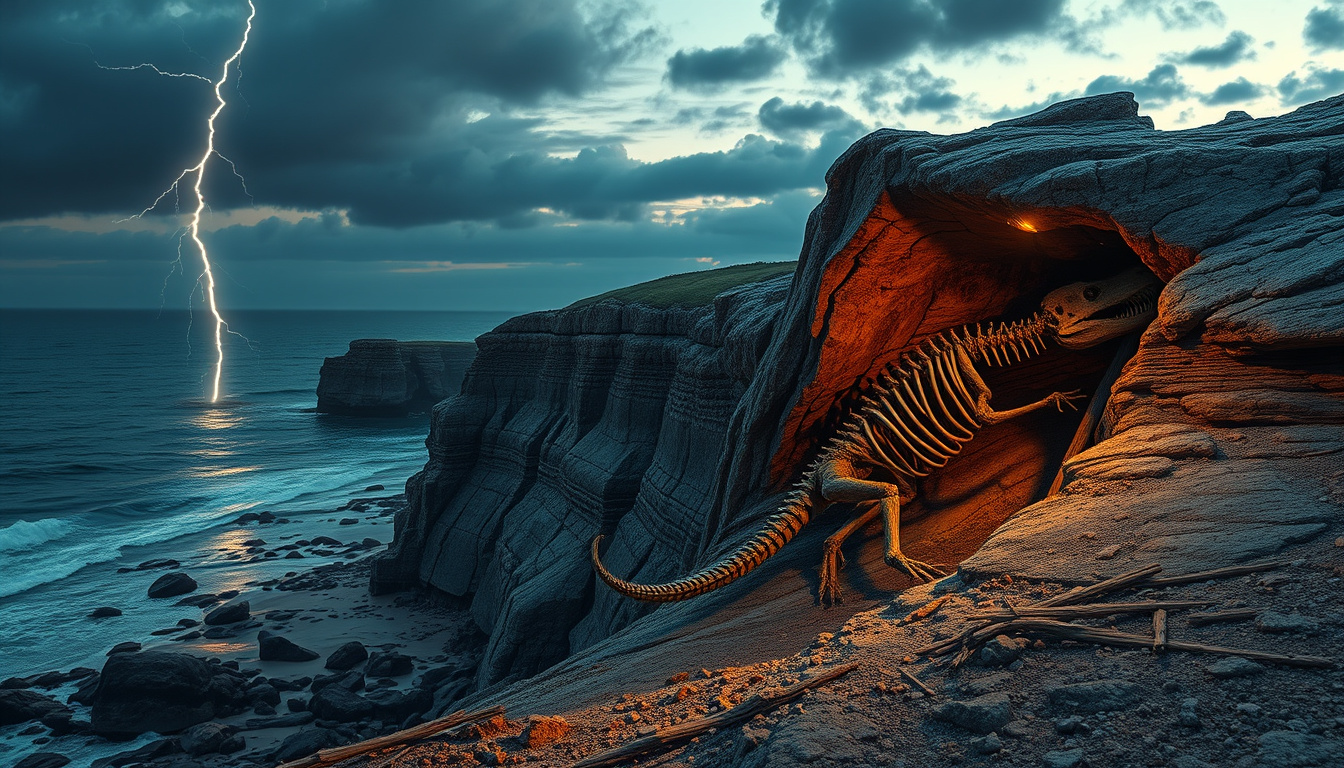
Imagine combing a beach as a child and unearthing a massive ancient sea monster — that’s exactly what happened to a young woman in Lyme Regis who would change science forever. Mary Anning turned a family trade into foundational contributions to paleontology, finding fossils that reshaped how we understand prehistoric life, all while being locked out of formal scientific circles because of her gender and class — a legacy that finally caught up with her work.
Born: 21 May 1799 ·
Died: 9 March 1847 ·
Known for: Fossil discoveries including Ichthyosaurus and Plesiosaurus ·
Key discovery age: 12 (first complete Ichthyosaurus) ·
Place of work: Lyme Regis, Dorset, England
Quick snapshot
- Born 21 May 1799 in Lyme Regis (Britannica, a comprehensive biographical reference)
- Discovered first complete Ichthyosaurus skeleton in 1811 (Natural History Museum, London)
- Struck by lightning in 1814 at age 15 (National Geographic Kids, educational publisher for young readers)
- Discovered first complete Plesiosaurus in 1823 (Oxford University Museum of Natural History, home to one of the world’s most significant fossil collections)
- Died of breast cancer on 9 March 1847 (Britannica, authoritative biographical source)
- Exact age at first Ichthyosaurus discovery — sources range from 10 to 13 (Britannica)
- Whether her brother Joseph found the initial specimen in 1810 (Britannica)
- Degree of romantic involvement with Charlotte Murchison is fictionalized in Ammonite (Britannica)
- Whether Anning was ever paid fairly for her fossil discoveries (Britannica notes limited financial records)
- The exact extent of her formal education and self-teaching (Britannica indicates little documented schooling)
- 1799 — Born in Lyme Regis (Britannica)
- 1811 — First complete Ichthyosaurus (Natural History Museum, London)
- 1814 — Lightning strike (National Geographic Kids)
- 1823 — First complete Plesiosaurus (Oxford University Museum of Natural History)
- 1828 — First pterosaur found outside Germany (Museum of the Earth, part of the Paleontological Research Institution)
- 1847 — Death from breast cancer (Britannica)
- Continued recognition through Lyme Regis Museum exhibitions (Lyme Regis Museum, dedicated to preserving her legacy)
- Films like Ammonite bring her story to new audiences (Lyme Regis Museum, dedicated to preserving her legacy)
- Royal Society named her among most influential women scientists (Royal Society)
Below is a quick-reference table of key facts about Mary Anning.
| Attribute | Detail |
|---|---|
| Full name | Mary Anning |
| Birth date | 21 May 1799 |
| Birth place | Lyme Regis, Dorset, England |
| Death date | 9 March 1847 |
| Occupation | Fossil collector and paleontologist |
| Key discovery | First complete Ichthyosaurus (1811) |
| Second major discovery | First complete Plesiosaurus (1823) |
| Marital status | Never married |
What is Mary Anning most famous for?
Ichthyosaurus discovery
At age 12, Mary Anning uncovered the first complete Ichthyosaurus skeleton in 1811 on the cliffs near Lyme Regis. The fossil was sold for a significant sum and brought her family much-needed income. The Natural History Museum (London’s premier paleontology institution) credits her with excavating and preparing the specimen, though credit was initially given to male scientists who published the find.
- The skeleton measured roughly 17 feet long
- It was one of the first complete prehistoric reptile fossils ever studied
- The discovery helped establish ichthyosaurs as a distinct group of extinct marine reptiles
A teenage girl with no formal education unearthed a specimen that professional geologists had failed to find — the find forced the scientific establishment to confront evidence that challenged biblical timelines of Earth’s history.
Plesiosaurus discovery
In December 1823, Anning discovered the first complete skeleton of a Plesiosaurus. The Oxford University Museum of Natural History (home to one of the world’s most significant fossil collections) calls this one of her most significant finds. The long-necked marine reptile became a sensation in scientific circles and sparked debate about whether such creatures could have existed.
- The specimen was so unusual that some initially suspected it was a forgery
- It provided key evidence for extinction — a radical idea at the time
- Georges Cuvier, the father of paleontology, later confirmed its authenticity
Contribution to paleontology
Beyond individual discoveries, Anning pioneered the study of coprolites (fossilized feces). The Oxford University Museum of Natural History notes she was among the first to recognize what these structures were and how they revealed ancient diets. Her meticulous field notes and fossil preparation techniques set standards still used today.
“Mary Anning was a pioneering palaeontologist whose discoveries revolutionised the way we understand the history of life on Earth.”
— Natural History Museum, London
The pattern is clear: each discovery chipped away at the era’s fixed ideas about life before humans, forcing the scientific community to reckon with evidence it could not explain away.
What did Mary Anning discover when she was 12?
The first complete Ichthyosaurus fossil
In 1811, Anning and her brother Joseph found what would become known as the first complete Ichthyosaurus skeleton. Britannica (a leading encyclopedia source) reports that the precise age attribution is uncertain — some sources say she was 10, others 12 or 13 — but the discovery was hers to excavate and sell. The fossil was purchased by a local collector for £23, a substantial sum that helped her family survive after her father’s death in 1810.
- The skeleton was nearly complete, a rarity at the time
- It was initially attributed to male naturalists who described it in scientific papers
- The specimen later ended up in the British Museum’s collection
Reaction of the scientific community
The Science Women resource (affiliated with the Smithsonian Institution) notes that Anning’s Ichthyosaurus was the first specimen of this type acknowledged by the Geological Society of London. Yet because women were barred from membership, she couldn’t present her own work. Male geologists like Henry De la Beche published papers based on her finds, often without naming her.
What this means: the scientific record of the time reflects institutional bias, not the actual source of the knowledge.
How old was Mary Anning when she was struck by lightning?
The lightning strike event
On a summer day in 1814, 15-year-old Mary Anning was struck by lightning while standing under a tree with three companions. The Britannica (comprehensive biographical reference) records that the strike killed the woman holding her and severely injured Anning herself. She survived, and the event quickly became local legend.
- The three others with her were all affected, with one fatality
- Anning’s survival was viewed as miraculous by her community
- The event contributed to her reputation as a charmed or remarkable child
Aftermath and folklore
According to National Geographic Kids (educational publisher for young readers), the lightning strike became part of Anning’s local fame, with some suggesting it gave her courage or luck in her fossil hunting. The folklore around the event persisted for generations, adding a layer of mystique to her already extraordinary life story.
“Her discoveries at Lyme Regis are some of the most significant geological finds of all time.”
The lightning strike, whether myth or miracle, helped cement her public identity as someone touched by fate — a narrative that sometimes overshadowed her scientific work.
Did Mary Anning ever marry?
Reasons she never married
Mary Anning never married, and historical records suggest a combination of social and economic factors prevented it. The Britannica (authoritative biographical source) indicates that her family’s poverty and lack of a dowry made a traditional marriage unlikely. As a working-class woman supporting her mother and brother through fossil sales, she lacked the financial security that 19th-century marriage required.
Social and economic factors
Her dedication to fossil work may have also played a role. The field was physically demanding and considered unsuitable for women of the era. Anning’s single status allowed her to continue her trade without the constraints of a husband’s authority.
The same independence that allowed Anning to pursue fossils professionally also kept her from the social respectability that marriage would have conferred in 19th-century England — a trade-off that shaped both her career and her exclusion from formal recognition.
The pattern: her personal choices were constrained by class and gender, but those constraints also carved the space for her groundbreaking work.
How true is the film Ammonite?
Historical accuracy of the film
The 2020 film Ammonite starring Kate Winslet is a fictionalized account of Mary Anning’s life. While it accurately depicts her as a skilled fossil hunter working in Lyme Regis, the central romantic storyline — a relationship with Charlotte Murchison — has no historical evidence to support it. Researchers have found no correspondence or documentation suggesting a romantic connection between the two women.
Key inaccuracies and dramatizations
The film takes creative liberties with Anning’s personality, portraying her as harsh and isolated, when historical accounts describe her as a respected local businesswoman. The Britannica (historical biography reference) notes that her actual life was more complex than the film’s simplified narrative suggests.
The catch: fictionalization can spark interest, but it also risks replacing the real person with a convenient narrative.
How did Mary Anning die?
Cause of death
Mary Anning died of breast cancer on 9 March 1847 in Lyme Regis. She was 47 years old. The Britannica (biographical reference work) records that her illness was painful and prolonged, and she continued working as long as she could. Her death marked the end of an era for Lyme Regis’s fossil trade, which she had dominated for decades.
Legacy after death
In the decades after her death, Anning’s contributions were largely overlooked by the scientific establishment. The Natural History Museum (London’s leading natural history institution) notes that it took more than a century for her work to be properly recognized. Today, she is celebrated through a blue plaque at her birthplace, an exhibition at the Lyme Regis Museum, and recognition by the Royal Society as one of the most influential British women scientists in history.
Modern paleontologists face a similar pattern: field workers and fossil preparers — often women or people from disadvantaged backgrounds — still see their names omitted from publications while their discoveries drive scientific advancement. Anning’s story is not just historical; it’s a living caution about attribution in science.
The implication: recognition delayed is not recognition denied, but the delay itself reveals systemic biases that persist today.
What was Mary Anning’s biggest discovery?
The Plesiosaurus discovery
Many historians and paleontologists consider Anning’s 1823 discovery of the first complete Plesiosaurus skeleton her crowning achievement. The American Museum of Natural History (world-renowned research museum) describes the find as groundbreaking because it provided definitive proof of a completely unknown type of marine reptile. The specimen’s long neck and four flippers challenged existing classification systems and forced scientists to reconsider the diversity of prehistoric life.
- The Plesiosaurus became the type specimen for the entire group
- Its discovery sparked debates about whether such creatures could have gone extinct
- The fossil was sold for £100 to the Duke of Buckingham
Other notable finds
Anning’s other major discoveries include the first pterosaur skeleton found outside Germany — Dimorphodon macronyx — which she unearthed in 1828. The Museum of the Earth (part of the Paleontological Research Institution) confirms this as a landmark find. She also identified belemnite fossils with their ink sacs preserved, and pioneered the study of coprolites, which revealed ancient diets.
“Mary Anning is widely regarded as the fossil hunter who helped establish the foundations of modern palaeontology.”
The pattern: her biggest discovery was also her most contested, yet it solidified the reality of extinction in the scientific mind.
en.wikipedia.org, womeninexploration.org, victorianweb.org, ucmp.berkeley.edu, encyclopedia.com, civicuk.uk
Frequently asked questions
Why did Mary Anning never marry?
Mary Anning never married due to a combination of family poverty, lack of a dowry, and her dedication to fossil collecting, which made marriage both economically and socially difficult in 19th-century England.
What is significant about the Pterosaur discovery made by Mary Anning?
In 1828, Mary Anning discovered the first pterosaur skeleton found outside Germany — Dimorphodon macronyx — which provided key evidence about the diversity of flying reptiles and expanded the known geographical range of pterosaurs.
What are coprolites and how did Anning contribute to their study?
Coprolites are fossilized feces. Mary Anning was among the first to recognize what they were and to use them to reconstruct the diets of ancient animals, pioneering a field that would become important in paleobiology.
How did Mary Anning’s discoveries affect the field of paleontology?
Her discoveries of complete Ichthyosaurus and Plesiosaurus skeletons provided key evidence for extinction and helped establish paleontology as a scientific discipline, challenging biblical timelines and forcing geologists to rethink the history of life on Earth.
What is the Lyme Regis Museum’s role in preserving Anning’s legacy?
The Lyme Regis Museum hosts a permanent exhibition dedicated to Mary Anning, displaying many of her finds and telling the story of her life and work, ensuring that her contributions continue to be accessible to the public.
For readers exploring Mary Anning’s life today, the Winston Churchill: Legacy, Controversies, and Key Facts and Prince Philip: Life, Death, and Legacy of the Duke of Edinburgh offer additional biographical perspectives on British historical figures whose reputations have evolved over time. The lesson from Anning’s story is straightforward: recognition in science should follow the evidence, not the social standing of the person who found it.

Freddie Clarke is Senior Reporter at WordPatch.co.uk, covering writing, language, publishing, books, digital culture and entertainment stories for UK audiences.