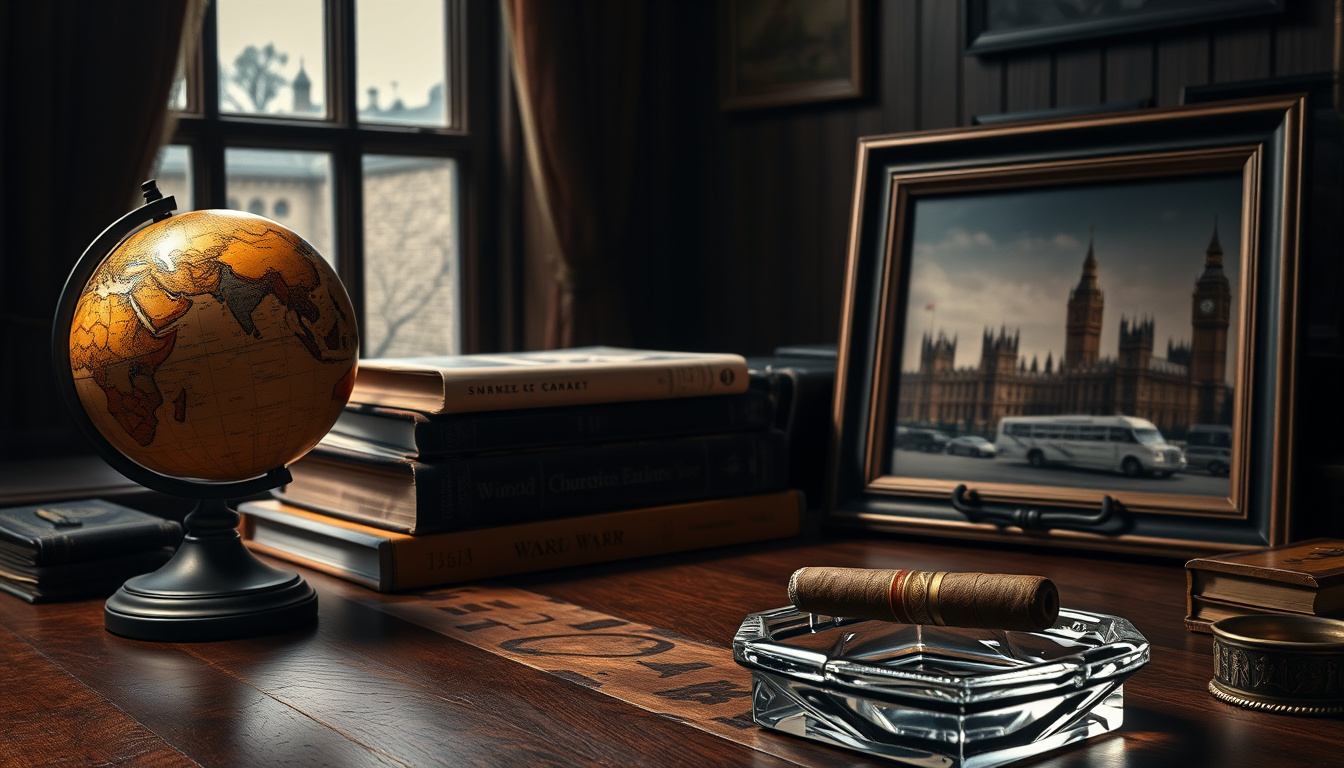
Few figures in modern history inspire as much admiration and criticism as Winston Churchill. The man who led Britain through its darkest hours was also a product of his imperial age, with personal habits and political views that continue to stir debate. This article examines the facts behind the legend—the victories, the controversies, and the man behind the cigar.
Born: 30 November 1874, Woodstock, Oxfordshire, England ·
Died: 24 January 1965, London, England ·
Prime Minister Terms: 1940–1945 and 1951–1955 ·
Nobel Prize: Literature, 1953 ·
Known For: Leadership during WWII, iconic speeches
Quick snapshot
- Churchill was Prime Minister during WWII (GOV.UK official UK government record)
- He won the Nobel Prize in Literature in 1953 (GOV.UK official UK government record)
- He was a heavy drinker by historical accounts (Churchill Archives Centre, University of Cambridge primary archive)
- Queen Elizabeth II wrote a letter after his death (BBC Newsround children’s news service)
- Whether Churchill was a nudist (allegations are anecdotal)
- Exact extent of his views on race (debated among historians)
- Precise depth of Hitler’s hatred of Churchill vs. Stalin (speculative)
- Born 30 November 1874 at Blenheim Palace (Encyclopaedia Britannica reference publisher)
- Appointed Prime Minister on 10 May 1940 (GOV.UK official UK government record)
- Died 24 January 1965 at age 90 (Encyclopaedia Britannica reference publisher)
- Ongoing historical reassessment of his imperial legacy
- Continued debate over his role in the Bengal famine
- New biographies and archival releases may clarify personal myths
Six key facts about Churchill, one pattern: they capture both his achievements and the controversies that still follow him.
| Attribute | Detail |
|---|---|
| Full name | Sir Winston Leonard Spencer-Churchill |
| Political party | Conservative (formerly Liberal) |
| Spouse | Clementine Hozier (married 1908) |
| Children | Diana, Randolph, Sarah, Marigold, Mary |
| Nobel Prize | Literature, 1953 |
| Height | 5 ft 6 in (168 cm) |
The pattern: a man of immense public stature whose private dimensions were often smaller — in height, in temper, and in the everyday habits that defined him.
What was Winston Churchill best known for?
Churchill is best remembered as the prime minister who steered Britain through the Second World War. He took office on 10 May 1940, the same day Germany invaded France, and refused to negotiate with Adolf Hitler even when Britain stood alone (GOV.UK official UK government record). His speeches — “We shall fight on the beaches,” “Blood, toil, tears and sweat” — became rallying cries that solidified national resolve.
He also won the Nobel Prize in Literature in 1953 for his historical writings, particularly his six-volume The Second World War (Churchill Archives Centre, University of Cambridge primary archive). Yet his legacy is not purely heroic. He was defeated in the 1945 general election just months after victory in Europe, a stark reminder that wartime leadership does not always translate to peacetime approval (GOV.UK official UK government record).
Churchill’s wartime heroism coexists with a record of imperial policies that modern historians judge harshly. The same man who saved parliamentary democracy also defended the empire that denied it to millions.
The implication: Churchill’s reputation is a mosaic of genuine courage and deep-seated contradictions that no single label can capture.
Was Churchill a Zionist?
Churchill’s relationship with Zionism was complex and evolved over decades. He supported the Balfour Declaration of 1917, which pledged British support for a Jewish homeland in Palestine, and later wrote a 1921 essay titled “Zionism versus Bolshevism” that argued for a Jewish state as a barrier against communism (Churchill Archives Centre, University of Cambridge primary archive). During his 1921 visit to Jerusalem, he approved the establishment of the Hebrew University and met with Jewish leaders.
However, his support was not unconditional. According to historians, Churchill’s Zionism was bound up with his imperial worldview — he saw a Jewish state as a strategic asset for the British Empire. The Gresham College academic lecture series notes that his views on India and racial hierarchies often contradicted his liberal rhetoric on Jewish self-determination.
The catch: Churchill’s Zionism was real but instrumental, a product of his time and his imperial calculations rather than pure altruism.
How did Churchill react to Hitler’s death?
On 30 April 1945, Adolf Hitler committed suicide in his Berlin bunker. Churchill received the news the following day and addressed the House of Commons on 7 May. His speech was measured — he said Hitler’s death “removes the greatest single obstacle to the establishment of peace” (Encyclopaedia Britannica reference publisher). He did not gloat; instead, he focused on the task of final victory.
According to the BBC News UK public broadcaster, Churchill’s reaction contrasted sharply with Stalin’s, who reportedly toasted Hitler’s death as “the just end of a monster.” Churchill’s restraint reflected his understanding that the war was won by the Allies, not by the death of one man.
Why this matters: Churchill’s reaction reveals a leader who understood the gravity of the moment and avoided personal triumphalism, a trait that set him apart from his Soviet counterpart.
What did the Queen say when Churchill died?
When Churchill died on 24 January 1965, Queen Elizabeth II sent a personal letter to his widow, Clementine. According to BBC Newsround children’s news service, the Queen wrote: “The whole world is the poorer by the loss of his incomparable personality.” She also granted Churchill a state funeral — an honour rarely given to a commoner and the last of its kind for a British prime minister.
The funeral, held on 30 January 1965, was a massive state occasion. The Queen herself attended, breaking protocol to show respect (GOV.UK official UK government record). The day saw the largest ceremonial gathering in British history, with leaders from 112 countries present.
The Queen’s letter and funeral attendance underscore the deep personal bond between the monarch and her first prime minister, a relationship that shaped the early years of her reign.
The trade-off: Churchill’s state funeral celebrated his wartime leadership, but it also papered over the controversies that many Britons, especially in former colonies, still remember.
Was Churchill a heavy drinker?
Churchill’s drinking is legendary, and historical accounts confirm it was substantial. The Churchill Archives Centre, University of Cambridge primary archive notes that he consumed whisky, champagne, and brandy daily, often starting with a whisky before breakfast. He famously said, “I have taken more out of alcohol than alcohol has taken out of me.”
His doctor, Lord Moran, reported that Churchill’s daily intake included about a bottle of champagne and several whiskies, but he rarely appeared drunk (BBC News UK public broadcaster). Modern medical estimates suggest he consumed the equivalent of four to five standard drinks daily, a level that would today be classified as heavy drinking.
Despite this, Churchill lived to 90, surviving strokes, pneumonia, and the stresses of war. Some historians argue that his robust constitution and regular exercise (he painted and gardened) offset the effects. The pattern: a man who defied medical norms, much as he defied political ones.
What was Hitler’s opinion of Churchill?
Adolf Hitler held Churchill in contempt. In his speeches, Hitler referred to Churchill as “that drunken Churchill” and “the warmonger” (Encyclopaedia Britannica reference publisher). According to the Gresham College academic lecture series, Hitler saw Churchill as a major obstacle to his plans for European domination, but he also believed that Churchill’s stubbornness would eventually break Britain’s will.
Did Hitler hate Churchill more than Stalin? That question is speculative. Hitler’s Mein Kampf and later writings show a deep ideological hatred for Stalin and communism, but he also despised Churchill as the symbol of British resistance. The BBC News UK public broadcaster notes that Hitler’s propaganda machine targeted Churchill personally, suggesting that he saw him as the driving force behind the Allied coalition.
The implication: Hitler’s personal animosity toward Churchill was real, but it was secondary to his ideological war against the Soviet Union. Churchill was the obstacle; Stalin was the enemy.
What is Winston Churchill’s most famous line?
Churchill’s most quoted line comes from his speech to the House of Commons on 4 June 1940, after the evacuation of Dunkirk: “We shall fight on the beaches, we shall fight on the landing grounds, we shall fight in the fields and in the streets, we shall fight in the hills; we shall never surrender” (Encyclopaedia Britannica reference publisher).
Another candidate is his first address as prime minister on 13 May 1940: “I have nothing to offer but blood, toil, tears and sweat” (GOV.UK official UK government record). And his tribute to the Royal Air Force after the Battle of Britain: “Never was so much owed by so many to so few” (BBC Newsround children’s news service).
Together, these three lines encapsulate Churchill’s rhetorical power: defiant, humble, and grand. The pattern: each speech was carefully crafted, not spontaneous, revealing a leader who understood the weight of words.
Churchill’s most famous lines are not just quotes — they are strategic instruments that defined the morale of a nation under siege. Their power lies in their simplicity and their truth.
Timeline: Key events in Churchill’s life
- 30 November 1874 – Born at Blenheim Palace (Encyclopaedia Britannica reference publisher)
- 1895–1898 – Military service in India and Sudan
- 1900 – Elected as Conservative MP (BBC Newsround children’s news service)
- 1915 – Gallipoli campaign – forced to resign from Admiralty
- 10 May 1940 – Appointed Prime Minister (GOV.UK official UK government record)
- 1940–1941 – Battle of Britain; Germany fails to defeat RAF
- 8 May 1945 – Victory in Europe Day
- 1946 – “Iron Curtain” speech in Fulton, Missouri
- 24 January 1965 – Death at age 90 (Encyclopaedia Britannica reference publisher)
Clarity: What’s confirmed and what’s still debated
Confirmed facts
- Churchill was Prime Minister during WWII (GOV.UK official UK government record)
- He won the Nobel Prize in Literature in 1953 (GOV.UK official UK government record)
- He was a heavy drinker by historical accounts (Churchill Archives Centre, University of Cambridge primary archive)
- Queen Elizabeth II wrote a letter to his widow after his death (BBC Newsround children’s news service)
- He supported the Balfour Declaration and Zionism (Churchill Archives Centre, University of Cambridge primary archive)
What’s unclear
- Whether Churchill was a nudist (allegations are anecdotal and unverified)
- Exact extent of his views on race (debated among historians; BBC notes he believed in racial hierarchies, but the depth is contested) (BBC News UK public broadcaster)
- Precise depth of Hitler’s hatred of Churchill vs. Stalin (speculative based on propaganda)
Quotes from and about Churchill
“We shall fight on the beaches, we shall fight on the landing grounds, we shall fight in the fields and in the streets, we shall fight in the hills; we shall never surrender.”
Winston Churchill, speech to the House of Commons, 4 June 1940
“I have taken more out of alcohol than alcohol has taken out of me.”
Winston Churchill, attributed
“The whole world is the poorer by the loss of his incomparable personality.”
Queen Elizabeth II, personal letter to Clementine Churchill, January 1965, as reported by BBC Newsround children’s news service
“That drunken Churchill”
Adolf Hitler, in speeches, referenced by Encyclopaedia Britannica reference publisher
Summary: Churchill’s words — whether spoken by him or about him — reveal a leader who inspired fierce loyalty and equally fierce opposition. The contrast between the Queen’s reverence and Hitler’s contempt underscores the global divide over his legacy.
Related reading: Prince Philip: Life, Death, and Legacy of the Duke of Edinburgh · John Adams: Biography, Slavery Views, and Last Words
m.digilib.k.utb.cz, en.wikipedia.org, gov.uk, en.wikipedia.org, youtube.com, casinotilbud.net
Frequently asked questions
Who was Winston Churchill?
Winston Churchill was a British statesman who served as Prime Minister of the United Kingdom from 1940 to 1945, during World War II, and again from 1951 to 1955. He is widely regarded as one of the greatest wartime leaders of the 20th century.
How old was Churchill when he died?
Churchill died on 24 January 1965 at the age of 90, just a few weeks after his 90th birthday.
Did Churchill serve in the military?
Yes, Churchill served as a cavalry officer in the British Army, seeing action in India, Sudan, and the Second Boer War. He was also a war correspondent.
How many times was Churchill Prime Minister?
Churchill served two non-consecutive terms: 1940–1945 and 1951–1955.
What famous speech did Churchill give during WWII?
His most famous speech is “We shall fight on the beaches,” delivered to the House of Commons on 4 June 1940 after the Dunkirk evacuation.
What was Churchill’s role in the Bengal famine?
Churchill has been criticized for his handling of the Bengal famine of 1943, with some historians arguing that his policies and wartime priorities worsened the crisis. The BBC Newsround children’s news service notes that he was accused of not doing enough to prevent it.
Was Churchill related to Princess Diana?
There is no direct familial relation. Princess Diana’s father was an Earl, but the Spencer family has historical connections to the Churchill family through marriage and social circles.

Freddie Clarke is Senior Reporter at WordPatch.co.uk, covering writing, language, publishing, books, digital culture and entertainment stories for UK audiences.