
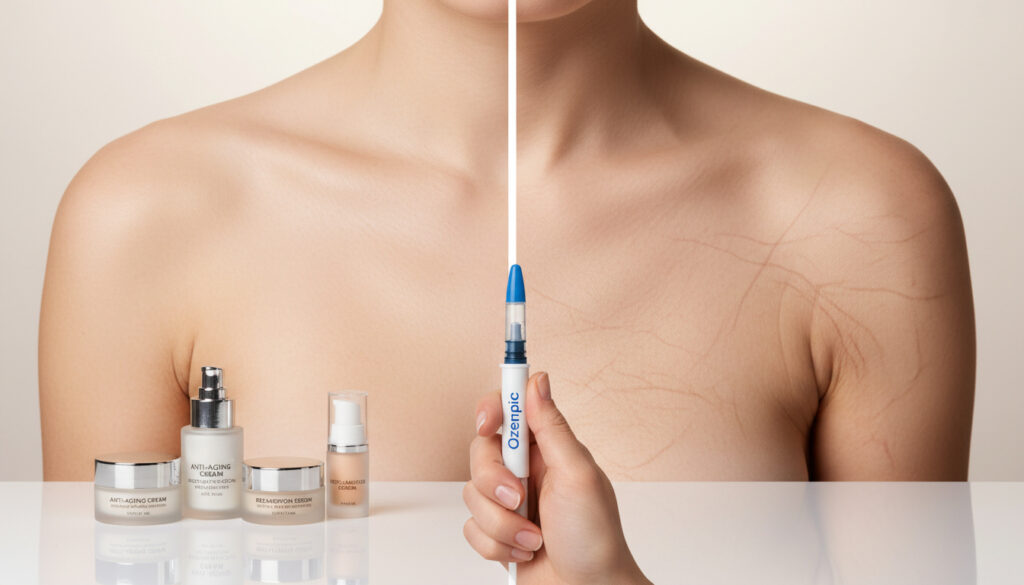
Rapid weight loss from GLP-1 medications like semaglutide has sparked a visible dermatological phenomenon colloquially termed “Ozempic face.” Documented clinical observations characterize this condition by hollowed cheeks, sunken eyes, and accelerated facial aging caused by swift adipose tissue reduction throughout the facial region.
The condition manifests when medications such as Ozempic or Mounjaro trigger substantial fat reduction indiscriminately across the body. Unlike gradual slimming, the swift depletion of subcutaneous facial volume leaves skin lax and unsupported, creating an unexpectedly gaunt appearance that often contrasts sharply with patients’ previous facial contours.
This investigation examines documented photographic evidence, physiological mechanisms, and therapeutic interventions associated with semaglutide-induced facial changes. Drawing from clinical documentation and verified patient transformations, we present a comprehensive analysis of how these medications alter facial architecture and what options exist for mitigation.
What Is Ozempic Face and What Causes It?
Primary Cause
Accelerated facial fat loss from GLP-1 receptor agonists including semaglutide and tirzepatide.
Visual Signature
Gaunt appearance with hollow temples, sunken cheeks, and pronounced wrinkling.
Typical Duration
Often temporary upon weight stabilization, though skin laxity may persist without intervention.
Corrective Approaches
Dermal fillers, surgical lifts, and controlled weight reduction protocols.
- GLP-1 medications reduce overall adipose tissue indiscriminately, including protective facial fat pads.
- Loss of midface volume creates gravitational sagging and skin laxity.
- Patients over 40 experience more pronounced skin looseness due to decreased collagen production.
- The phenomenon has been documented in both celebrity photographs and clinical patient records.
- Dermatologists note the texture changes resemble accelerated aging rather than simple slimming.
- Hyaluronic acid fillers represent the primary non-surgical intervention.
| Facial Aspect | Before Ozempic | After Ozempic | Physiological Notes |
|---|---|---|---|
| Cheek Volume | Full, rounded contours | Hollow, angular appearance | Loss of buccal fat pads |
| Temple Region | Smooth, filled | Sunken, skeletal | Temporal fat pad depletion |
| Under-Eye Area | Plump, minimal shadowing | Deepened tear troughs | Orbital fat reduction |
| Jawline Definition | Soft, continuous line | Prominent jowls, hanging skin | Skin laxity from rapid volume loss |
| Skin Texture | Elastic, thick | Crepey, paper-thin | Reduced dermal support |
| Wrinkle Depth | Fine lines | Pronounced nasolabial folds | Loss of structural support |
Ozempic Face Before and After: Real Examples
What Does Ozempic Face Look Like in Photos?
Before initiating treatment, patients typically display fuller facial contours with rounded temples and robust cheekbones. Post-treatment imagery reveals dramatic shifts: cheeks appear sucked inward, temples hollow, and the under-eye region develops deep shadows. The jawline often presents loose, hanging skin rather than clean definition, particularly in patients over 40.
Celebrity Transformations and Documented Changes
Side-by-side photographic analyses reveal Kathy Bates displaying less plump cheek volume and sagging jawline contours following 20 pounds of medication-assisted weight loss. Claudia Oshry’s 70-pound reduction resulted in markedly hollow cheeks and prominent chin structure compared to earlier fuller-faced appearances.
Renee Graziano’s documented 52-pound loss on Mounjaro shows similar temple hollowing and cheekbone prominence diverging from her 2016 baseline. Real patient examples from plastic surgery practices depict these shifts, with post-weight loss faces appearing angular and aged despite slimmer bodies. Meghan Trainor’s post-pregnancy Mounjaro use has been associated with gaunt jawline presentations in recent photography.
Real patient examples from plastic surgery practices depict faces appearing angular and aged despite bodies appearing slimmer, confirming the phenomenon extends beyond celebrity speculation into documented clinical reality.
How to Prevent and Fix Ozempic Face
Prevention Through Controlled Weight Management
Mitigating facial volume loss begins with modulating the pace of weight reduction. Gradual fat depletion allows skin elasticity mechanisms to adapt, potentially reducing laxity. Maintenance of hydration and collagen-supporting nutrition may provide additional structural support, though specific efficacy data remains limited in current literature.
Non-Surgical Volume Restoration
Dermatologists frequently recommend hyaluronic acid injectable fillers to restore cheek and temple volume. These treatments plump under-eye hollows and smooth perioral wrinkles without surgical intervention. Volume replacement strategies specifically target the structural support lost during rapid adipose tissue reduction.
Surgical Interventions for Advanced Cases
For patients with significant skin laxity, surgical options provide more permanent solutions. The MACS-lift (Minimal Access Cranial Suspension) re-tightens midface and jawline tissue while correcting underlying muscle position. Traditional facelifts and neck lifts target hanging skin and hollows to restore natural lower facial contours. Body contouring procedures address excess skin unresponsive to medication cessation.
Is Ozempic Face Permanent and Who Is at Risk?
Reversibility and Long-Term Prognosis
Changes are not necessarily permanent when addressed promptly. Procedural interventions can yield natural, long-lasting appearances, particularly the MACS-lift technique. However, untreated sagging may persist indefinitely without surgical or filler intervention. Complete spontaneous reversal without aesthetic procedures remains unconfirmed in current medical literature.
Individuals over 40 face elevated risk due to naturally declining collagen production. Those losing weight rapidly—regardless of total pounds lost—demonstrate higher incidence of significant facial volume depletion compared to gradual weight loss cohorts.
Distinguishing Medication Effects From Natural Aging
While natural aging gradually reduces facial volume, Ozempic face accelerates this process disproportionately to chronological age. The rapidity of change—from full to gaunt within months rather than years—characterizes the medication-induced variant. Comparative photography demonstrates these transformations occurring independently of normal age progression. Om du är orolig för att du kan ha ALS, finns det mer information om symtom och diagnos här: $Tror jag har ALS
Patients noticing initial hollowing may benefit from immediate dermatological consultation. Early filler application prevents the cascading effect of unsupported skin sagging, potentially reducing the need for more invasive surgical corrections later.
When Did the Ozempic Face Phenomenon Emerge?
- : Social media platforms first document viral before-and-after comparisons highlighting unexpected facial aging.
- : Medical communities begin identifying “Ozempic face” as a distinct clinical observation separate from general weight loss effects.
- : Plastic surgery practices report increased consultation requests specifically citing GLP-1 medication side effects.
- : Celebrity photographs generate mainstream media coverage of the phenomenon.
- : Dermatology journals publish initial clinical observations regarding treatment protocols for semaglutide-induced facial changes.
What Do We Know for Certain About Ozempic Face?
| Established Facts | Remaining Uncertainties |
|---|---|
| GLP-1 agonists cause rapid facial fat loss | Exact percentage of patients affected |
| Fillers and surgery can restore volume | Long-term natural recovery without intervention |
| Older patients experience more skin laxity | Specific weight loss velocity thresholds |
| Celebrity cases match clinical observations | Prevention protocol efficacy rates |
Why Is Ozempic Face Generating Significant Attention?
The phenomenon intersects with broader cultural conversations regarding pharmaceutical weight loss and aesthetic standards. Unlike body changes concealable through clothing, facial transformations remain publicly visible, creating psychological distress for patients seeking health improvements. The contrast between slimmed bodies and aged faces challenges conventional beauty paradigms, prompting debate about the trade-offs of rapid medical weight loss. Similar to how cultural phenomena like South Park Season 27 – Release Dates Episodes Guide capture public imagination through social commentary, Ozempic face has become a touchpoint for discussions about modern medical aesthetics.
What Does Medical Research Indicate?
Accelerated fat loss from semaglutide reduces overall body fat including facial volume, leading to loss of midface fat support causing skin laxity and gravitational sagging.
— Clinical Documentation, HubMedEd
MACS-lift procedures offer minimal incisions and shorter recovery than traditional facelifts while providing long-lasting correction for Ozempic-induced laxity.
— Lynch Plastic Surgery Clinical Gallery
Essential Insights on Ozempic Face Transformations
Ozempic face represents a documented physiological response to rapid GLP-1 medication weight loss, characterized by facial hollowing and skin laxity. While photographic evidence confirms significant aesthetic impacts across demographic groups, various interventions—from hyaluronic fillers to surgical lifts—offer viable restoration pathways. The condition appears reversible through procedural intervention, though spontaneous recovery remains uncertain. Understanding these potential outcomes enables informed decision-making regarding pharmaceutical weight management, much as knowing How Many Pints of Blood in the Human Body – Averages by Age and Gender informs medical awareness.
Frequently Asked Questions
What exactly causes the sunken cheek appearance?
Semaglutide and tirzepatide reduce subcutaneous fat throughout the body, including the buccal fat pads in the cheeks. This rapid volume loss eliminates the structural support that maintains youthful facial contours, creating hollowed appearances.
Can facial exercises prevent Ozempic face?
While facial exercises may improve muscle tone slightly, they cannot replace lost fat volume or restore skin elasticity once significant adipose tissue has depleted. They serve as adjunctive rather than primary prevention methods.
How quickly does Ozempic face develop?
Facial changes typically become noticeable within three to six months of consistent medication use, correlating with rapid weight loss phases. The exact timeline varies based on age, initial facial volume, and total weight reduction velocity.
Are the changes reversible if I stop the medication?
Discontinuing medication may halt further fat loss, but existing facial hollowing generally persists without aesthetic intervention. Some mild improvement might occur with weight regain, though skin laxity usually requires fillers or surgery to correct.
Does Ozempic face affect everyone equally?
No. Individuals over 40, those with naturally lean faces, and patients experiencing rapid weight loss face higher risks. Genetic factors influencing skin elasticity and fat distribution also contribute to individual variation in severity.
How do fillers compare to surgical options?
Hyaluronic acid fillers offer temporary volume restoration with minimal downtime but require maintenance injections. Surgical lifts provide permanent structural correction but involve recovery periods and higher procedural risks.
Can I avoid Ozempic face while still losing weight?
Gradual weight loss protocols may reduce severity, but complete prevention remains challenging for many patients. Proactive dermatological consultation during the weight loss process allows for early intervention strategies.

Amelia Foster is Books & Publishing Editor at WordPatch.co.uk, covering book releases, publishing industry updates, author interviews, literary culture and UK publishing trends.